
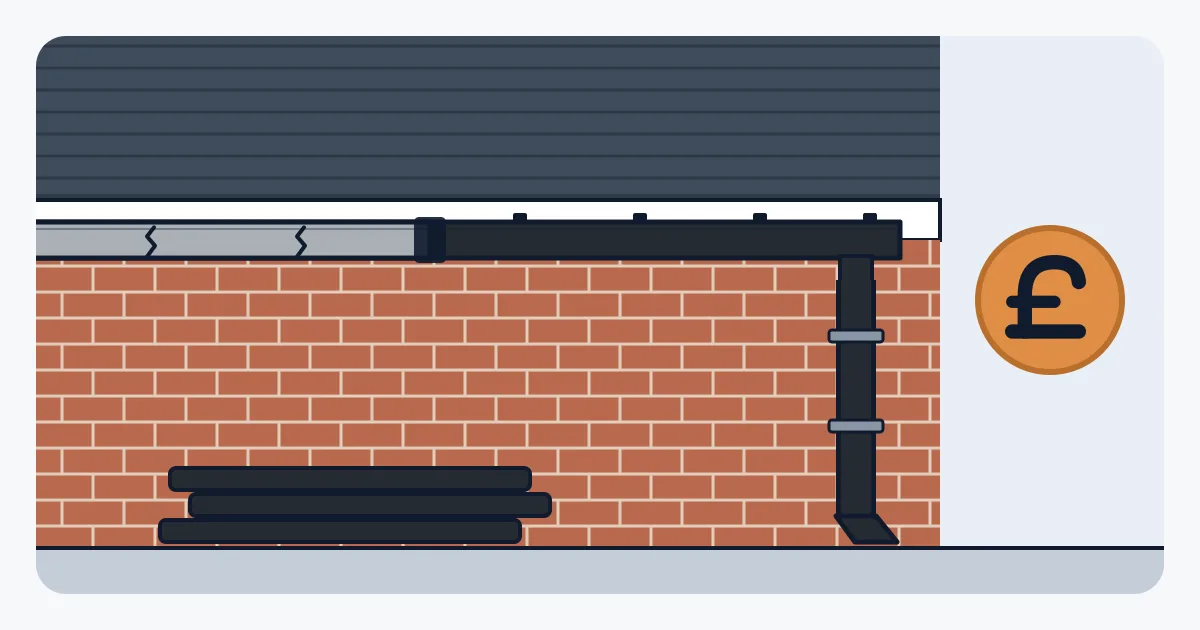
Gutter replacement typically costs between £650 and £1,800 for a UK house. That covers stripping out the failed lengths, fitting new guttering with matching brackets, angles and outlets, and connecting it to sound downpipes or to new ones where the quote includes them. Most domestic jobs in that range are uPVC. Cast iron, bespoke aluminium and very long or awkward runs can cost more.
The figure people find hardest to judge is how far a replacement price should move between houses that look alike. Two semis on the same street can be quoted several hundred pounds apart because one has a conservatory under the rear gutter and the other doesn't. This guide sets out what each part of the range usually buys, so you can tell whether a quote is pricing the work or the difficulty of reaching it.
Gutter replacement prices by job size
Indicative UK costs for replacing domestic guttering
| Scope | Typical cost | What it usually includes |
|---|---|---|
| One elevation or a small terrace | £650–£900 | Front or rear run in uPVC, one or two outlets, ladder or small tower access, old gutter taken away |
| Whole house, semi-detached | £900–£1,300 | All gutter runs in uPVC, new outlets and corners, downpipes renewed or reconnected |
| Detached, metal or scaffolded | £1,300–£1,800+ | Longer runs with several corners, aluminium systems, or scaffold needed over extensions or steep ground |
Cast iron replacement on a period house usually sits above this table. The material, the weight of each length and the extra hands needed to lift it all add cost, and a like-for-like heritage system is a different purchase from standard plastic.
Metres matter less than you'd think
It's tempting to divide a quote by the length of gutter and compare a per-metre figure. In practice, the straight lengths are the cheap part. The parts that cost money are:
- Corners and angles. Every internal or external angle is a fitting, two joints and extra setting-out time. An L-shaped house with a bay can have twice the fittings of a plain rectangle the same length
- Outlets and downpipes. New outlets are often moved to suit the new fall, and if the downpipes are tired the quote may include renewing them. Ask whether retained downpipes are being checked or simply reconnected
- Access. A tower for one elevation is a modest line item; scaffold wrapped round a detached house can be the single largest cost in the quote
- What's found behind the old gutter. Brackets come off and reveal the fascia. A soft board needs repair or replacement before new brackets can hold, which is why good quotes carry an allowance for damaged fixing surfaces
- Disposal. Old plastic and especially old cast iron have to go somewhere, and a quote should say whether removal is included
uPVC, aluminium and cast iron: how material moves the price
uPVC is the default on most houses because it's light, quick to fit and available in many profiles and colours, which is why the lower and middle tiers above assume it. Aluminium systems, including seamless lengths formed on site, generally cost more but suit owners who want fewer joints or a slimmer look. Cast iron is the costliest and is usually chosen to match the character of an older or listed building.
If only part of the house is being replaced, the cheapest material isn't always the cheapest job. Joining a new profile to an old one needs an adaptor that actually exists for both systems. Matching the existing shape and colour can be simpler and, on a terrace, kinder to the neighbour whose run continues from yours.
Check it names the product range and colour, the number of outlets and corners, what happens to the downpipes, and how damaged fascia found during removal will be priced and agreed. If two quotes differ a lot, compare their access lines first.
When replacement is the right call
Replacement makes sense when several lengths have gone brittle, the system's seals or unions can't be sourced any more, or years of patches have left mismatched sections that no longer line up. If the guttering is mostly sound and one area is at fault, gutter repairs are usually far cheaper. Our gutter repair cost guide sets out that range. If you aren't sure which you're looking at, gutter problems explained works from the symptom to the likely fix.
If the fascias are also soft or the soffits are coming apart, replacing everything together while access is up may be better value than two visits. A fascia, soffit and guttering replacement is priced in our roofline replacement cost guide.
To try different job sizes and services side by side, use the guttering cost calculator.
Frequently asked questions
How much does it cost to replace guttering on a semi-detached house?
As a guide, a full uPVC replacement on a typical semi falls around £900–£1,300. Extensions, conservatories under the gutter line or a need for scaffold rather than a tower can push it higher.
Is it worth replacing downpipes at the same time?
Often, if they're the same age as the gutter and access is already in place. Sound downpipes can be reconnected, but ask the installer to check the sockets, clips and shoes rather than assuming they're fine.
Does a gutter replacement quote include VAT?
Not always. Some sole traders aren't VAT-registered and some quotes are given excluding VAT, so ask for the total you'll actually pay, including access, materials and disposal.
How long does gutter replacement take?
Typically one to two days for a domestic house. A single elevation can be done in a few hours, while a detached house with scaffold may take longer once the scaffold itself is allowed for.
Ready to talk to a gutter replacement specialist?
Get Free Quotes →