
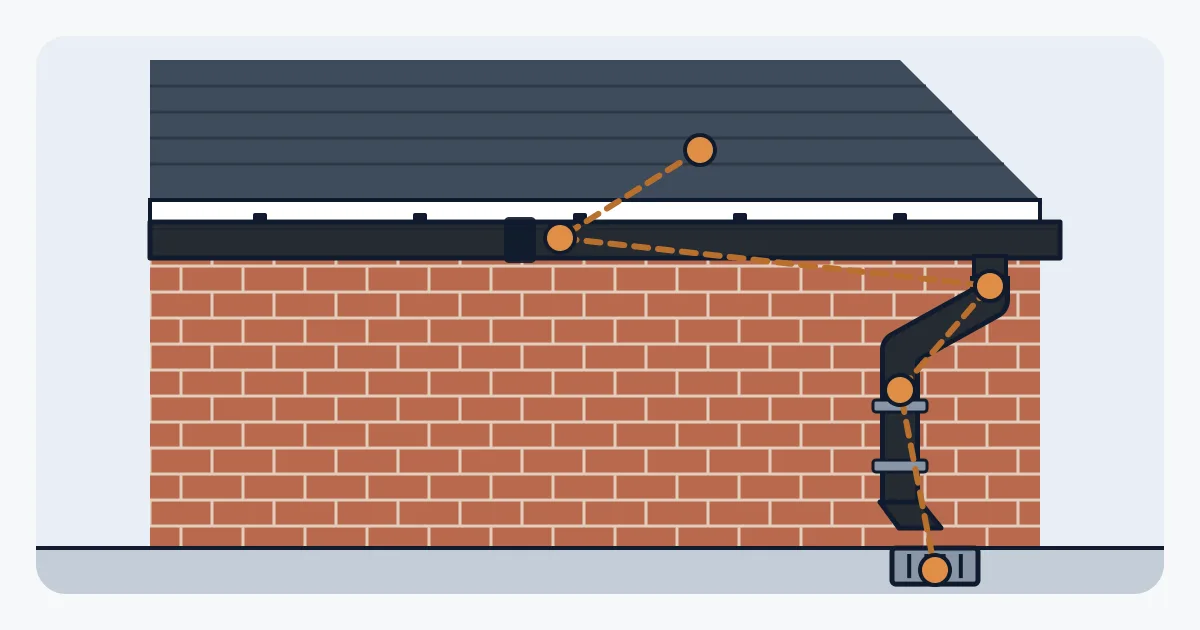
Most gutter problems come back to one job going wrong: a guttering system has to take the water that runs off your roof and deliver it to a drain without letting it touch the walls. When something fails, the place you notice it is rarely the place it started. Water escapes, runs along the gutter's underside or down the brickwork, and shows up as a drip, a stain or a puddle somewhere downstream.
So rather than starting from the symptom, this guide follows the water. There are six stages between the roof and the drain, and each one fails in its own recognisable way. Work out which stage has failed and you've usually worked out which of our six services you need, and roughly what it'll cost.
Stage 1: gutter problems at the roof edge
Water should leave the last row of tiles or slates and drop into the middle of the gutter. If the gutter sits too low on the fascia, or the felt or eaves tray at the roof edge doesn't reach into it, water can run down behind the gutter instead. Look for wet fascia and a wet wall directly beneath the gutter, along a stretch rather than at one point, often with the gutter itself looking fine.
Gutter position can be corrected as part of gutter repairs or gutter replacement. If the problem lies in the roof edge itself, a roofer may need to look at it too.
Stage 2: gutter problems in the channel
Once in the gutter, water needs a gentle fall towards an outlet. Two things go wrong here. The gutter can sag, because a bracket has dropped or the board behind it has gone soft, leaving a low point where water sits. Or a length can crack, usually along the bottom or near a fitting, letting water out through the body of the gutter.
- A visible dip, or water standing in the gutter after rain has stopped: a support or fall problem, fixed by gutter repairs. See the gutter repair cost guide
- Drips from somewhere along a plain length, not at a joint: probably a crack, and a job for leaking gutter repairs
- Many lengths brittle, faded or split: the system is wearing out, and gutter replacement is worth pricing. See the gutter replacement cost guide
Stage 3: gutter problems at the joints
Most gutters are made of lengths joined by unions, corners and stop ends, each with a rubber seal. These are the most common leak points on any plastic system. The giveaway is a drop forming directly under a fitting, or a neat vertical streak beneath one corner. If the gutter lengths either side look sound, this is the cheapest fix on the list: gutter joint and seal repairs, priced in our joint and seal repair cost guide.
If the same union fails again after a reseal, look upstream. A sagging length can pull a joint apart, and a gutter fitted without room to expand can push it apart. Fixing the seal alone won't hold.
Stage 4: the outlet
The outlet is where the gutter hands water to the downpipe. A partly blocked outlet, or one placed too far from the lowest point of the run, makes the gutter fill faster than it drains. In practice that means water pouring over the front edge during heavy rain, often near the outlet or at the far end of a long run, but no drips in light rain.
This is the problem most often mistaken for a leak. Clearing the outlet may be all that's needed, but if the gutter overflows even when it's clear, the outlet position, the gutter size or the downpipe may be wrong for the area of roof it serves. That's usually addressed as part of gutter replacement, not by sealing anything. Our guide to what size gutter you need explains how outlets and roof area set the capacity.
Stage 5: downpipe and gutter problems
The downpipe carries the water down the wall on clips, often through an offset bend under the eaves. When it fails, expect the pipe moving or standing off the wall, water escaping from a socket partway down, a split along its length, or a hopper on an older house spilling over. These are jobs for downpipe replacement and repairs; see the downpipe cost guide.
Stage 6: the discharge
At the bottom, the downpipe should empty into a gully or connect to an underground drain. If that's blocked, the water has nowhere to go and backs up the pipe, escaping at the lowest weak joint, or even overflowing at the outlet two storeys up. Typical signs are a gully that stays full during rain, water pooling at the foot of the pipe, or every joint on one pipe leaking at once.
A new downpipe won't fix a blocked drain. The drain needs its own investigation. If the shoe at the bottom has gone missing and water is simply landing beside the gully, that is a quick downpipe repair.
And behind it all: the fascia
Every stage above relies on the fascia board holding the gutter brackets firmly. When timber fascias rot, brackets loosen one by one, the gutter starts to sag and joints get pulled apart. Expect brackets that won't stay tight, flaking paint and soft patches on the board, soffit panels opening at their edges. If the boards themselves are failing, the lasting fix is usually a combined fascia, soffit and guttering replacement, priced in our roofline replacement cost guide.
Quick reference
Where the water shows, and the service most likely to fix it
| What you see | Likely stage | Service to ask for |
|---|---|---|
| Drop forming under one fitting | Joint | Joint and seal repairs |
| Drips from a plain length | Channel (crack) | Leaking gutter repairs |
| Water standing in a dip | Channel (fall) | Gutter repairs |
| Overflow in heavy rain only | Outlet or capacity | Gutter repairs or replacement |
| Wet wall behind the gutter along a stretch | Roof edge or gutter position | Gutter repairs |
| Pipe loose, split or spilling | Downpipe | Downpipe repairs |
| Gully full, pipe joints all leaking | Discharge or drain | Drain investigation first |
| Soft boards, brackets won't hold | Fascia | Fascia, soffit and guttering replacement |
Once you know which service you need, the guttering cost calculator gives a budget range for it. For a checklist of what to look for and how urgently to act, see signs your guttering is failing. If these problems have come up in a survey on a house you're buying, our guide to what to do when a survey flags the guttering covers the next steps.
How to trace a gutter problem from roof to drain
- Wait for rain, or note when the problem appears
Most gutter faults only show while water is flowing. If you can, look during or just after steady rain, and note whether the problem appears in light rain or only in heavy downpours.
- Start at the roof edge
From the ground, look along the eaves. Is water landing in the gutter, or running down the fascia and wall behind it along a stretch?
- Follow the gutter run
Look along the gutter for dips, standing water, drips from plain lengths and drops forming beneath unions, corners and stop ends. Binoculars help on upper storeys.
- Check the outlet
Look at the run either side of the outlet. Water spilling over the front edge here in heavy rain points to a restricted outlet or a capacity problem rather than a leak.
- Follow the downpipe down
Check that the pipe is tight to the wall, that clips are present, and that no water escapes from sockets or bends on the way down.
- Finish at the gully
See whether the shoe sits over the gully and whether the gully drains or fills up. A full gully suggests the drain, not the pipe, is the cause.
- Describe the stage in your enquiry
Tell the contractor which stage the water escapes from and when. Photos or a short video taken safely from the ground make diagnosis quicker and quotes more accurate.
Frequently asked questions
Why is my gutter overflowing when it isn't blocked?
The outlet may be too small or too far from the low point, the gutter may have lost its fall, or the downpipe may be backing up from a blocked drain. In some cases the gutter is simply too small for the roof area draining into it.
Is a leaking gutter an urgent repair?
Not usually an emergency, but water running down a wall for months can lead to damp patches, stained brickwork and rotting fascia. It's worth getting it fixed before winter.
How can I tell if my fascia board is rotten from the ground?
Look for flaking or blistered paint, dark staining, brackets that have pulled away, and a gutter that sags along several brackets rather than one. A contractor can confirm by checking the timber close up.
Should I climb a ladder to check my gutters?
It's safer to look from the ground, using binoculars or a phone camera's zoom, and let a contractor with a tower or proper ladder set-up do the close-up check.
Ready to talk to a gutter replacement specialist?
Get Free Quotes →