
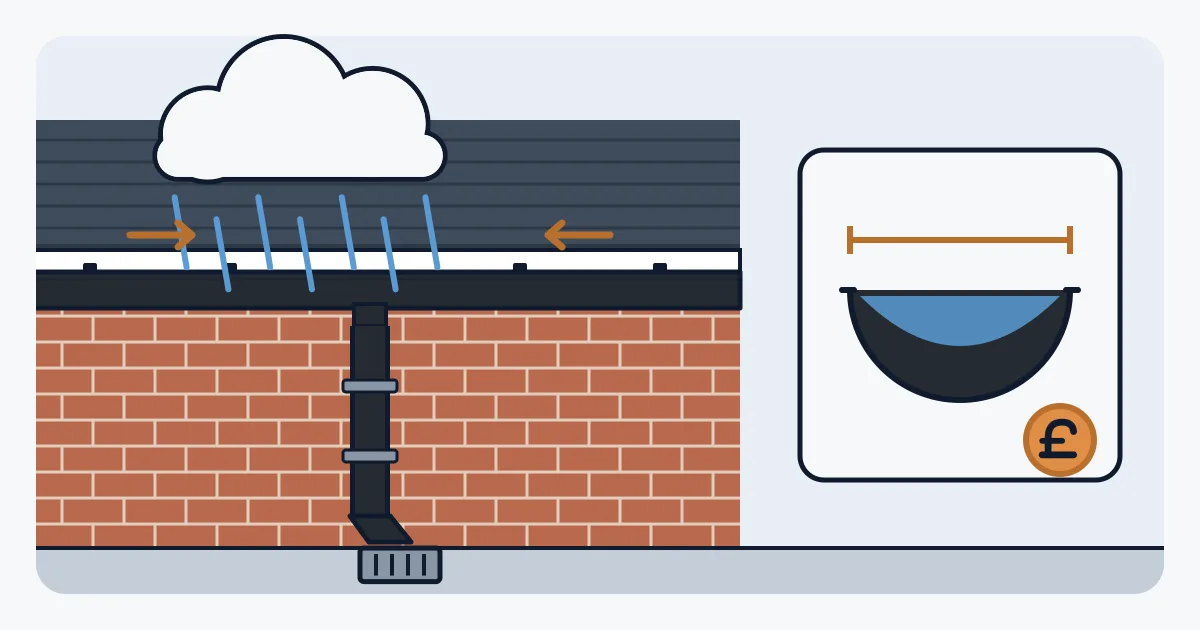
What size gutter do you need? That depends less on the house than on how much water the roof sends to each outlet in a heavy storm. The main factors are the area of roof draining into the gutter, how many outlets there are and where they sit, and the size of the downpipe taking the water away. This guide explains the method so you can ask a contractor sensible questions, without a flow table that only a manufacturer should publish.
What size gutter: how the design method works
The standard method for roof drainage is set out in BS EN 12056-3, and in England the rainwater requirement sits in Part H3 of Approved Document H. Both start with the same idea. You work out how much rain a given area of roof can send into the gutter in a heavy shower, then check that the gutter and its outlets can carry that flow.
Most homes don't need an engineer to do this. Installers use the capacity guidance that comes with each system. Even so, knowing the factors helps you spot a quote that has guessed.
What size gutter depends on roof area and pitch
A long, wide roof slope sheds far more water to its gutter than a short one. A big rear extension roof draining onto a main gutter adds its own flow too. Pitch matters because steep roofs shed water faster, and wind-driven rain on exposed sites can send more water to the eaves than the plan area suggests.
So measure what drains where. A single long run on a large roof can need more capacity than two short runs of the same total length with an outlet each.
Outlets change what size gutter you need
A gutter is only as good as the outlets that empty it. An outlet in the middle of a run splits the flow in two directions, so each half carries less. An outlet at one end makes the whole run drain one way. Adding a second outlet to a long run is often a cheaper fix for overflow than buying a bigger gutter.
A larger gutter feeding a downpipe that is too small, or one clogged with silt, will still overflow. That's why the gutter replacement templates stress checking the whole route from roof to drain, not just the gutter.
Downpipe size sets the limit
Domestic downpipes are commonly around 68 mm round or 65 mm square, though other sizes exist. The pipe, the outlet it connects to and the gully or drain at the bottom all have to cope. If a gutter overflows at the outlet while the downpipe runs half empty, the outlet is the weak point. If the downpipe itself backs up, look at the downpipe replacement and repairs service and our downpipe cost guide.
Gutter width and profile
Typical domestic half-round gutters are about 100–115 mm across, and larger or deeper profiles carry more. Square and ogee shapes have their own capacities, and shape alone doesn't tell you which one moves more water. Our gutter profiles comparison sets the shapes side by side.
What to measure or ask before choosing a size
| Factor | What to measure or ask | Why it matters |
|---|---|---|
| Roof area to each gutter | Length and slope depth of each roof plane draining in | More area means more flow to carry |
| Pitch and exposure | Steep roof, hillside or coastal site | Exposed roofs can see heavier run-off in storms |
| Outlets | How many, and where on the run | A central outlet halves the distance water travels |
| Downpipe | Diameter and shape, and what it connects to | It caps the flow however big the gutter is |
| Falls | Gentle, even slope towards each outlet | Too flat and water pools. Too steep and it overshoots corners |
| Extensions and valleys | Any roof draining onto another roof | These concentrate flow at one point |
Where to check the real numbers
Manufacturers such as FloPlast, Marley and Brett Martin publish technical guidance for their own systems, including how much roof each gutter and outlet combination can serve. Those tables are the right place for figures. Use the maker's guidance for the exact system on your quote. FloPlast also answers common installation questions in its rainwater FAQs.
What to ask your contractor
- Which roof areas does each outlet drain, and why have you put the outlets there?
- What size is the downpipe, and does it match the outlet?
- Is any of the run too long for one outlet?
- Have you allowed for an extension roof draining onto the gutter?
- Which manufacturer's guidance are you working from?
If you're deciding whether to renew at all, start with repair or replace guttering. Then use the gutter replacement cost guide to see what a larger or extra-outlet system adds to the price.
Frequently asked questions
Will a bigger gutter stop my gutters overflowing?
Not always. Overflow often comes from a blocked or undersized outlet, a downpipe that can't keep up, or poor falls. Check the whole route before paying for larger gutters.
How many downpipes does a house need?
It depends on the roof area and run length. Long runs often need an outlet at each end or in the middle, so a contractor should explain why each downpipe sits where it does.
Is a deep-flow gutter better than half-round?
It carries more water per run, which helps on large roofs or exposed sites. It also looks different and costs more, so it's worth it only where the capacity is needed.
Ready to talk to a gutter replacement specialist?
Get Free Quotes →